
If you’ve been told you have a bulging disc or a herniated disc, you may wonder whether those terms mean the same thing—and which one is worse.
They aren’t exactly the same, although both describe changes involving the discs between the bones of your spine.
More importantly, neither term tells us everything about how you will feel.
Some people have disc changes on imaging and experience significant pain, numbness, or weakness. Others have similar findings and very few symptoms. Understanding the difference starts with understanding what a spinal disc actually does.
What Is a Spinal Disc?
Your spine is made up of individual bones called vertebrae. Between most of those vertebrae are intervertebral discs, which help absorb and distribute forces while allowing the spine to move.
Each disc has two primary components.
The annulus fibrosus is the tougher outer portion of the disc, while the nucleus pulposus is the softer, gel-like material inside.
You can think of the disc as a strong outer ring surrounding a softer center, although the actual anatomy is more complex than the common “jelly doughnut” comparison suggests.

Like many structures in the body, discs change over time. They can lose hydration, become less flexible, or change shape. Injury, repetitive loading, genetics, age, and other factors can all influence those changes.
What Is a Bulging Disc?
A disc bulge occurs when part of the outer edge of the disc extends beyond its normal boundary.
The key distinction is that a bulge generally involves a broader portion of the disc’s circumference. The disc hasn’t necessarily “burst,” and the inner material hasn’t simply fallen out.
Imagine pressing down gently on a cushion and watching its sides expand outward. That’s not a perfect anatomical comparison, but it helps illustrate the general concept.
A bulging disc can occur in the neck or lower back and doesn’t automatically cause symptoms.
In fact, disc bulges are commonly found on imaging in people who have no back pain at all.
What Is a Herniated Disc?
A herniated disc is a more localized displacement of disc material.
Rather than a broad portion of the disc extending outward, material from inside the disc pushes through or into a weakened area of the outer portion.
You may also encounter terms such as disc protrusion or disc extrusion on an imaging report. These describe different appearances and degrees of displaced disc material.
Again, the terminology can sound alarming, but an MRI finding alone doesn’t determine how serious someone’s condition is.
What matters is how that finding relates to the person’s symptoms and examination.
So, Is a Herniated Disc Worse Than a Bulging Disc?
Not necessarily.
A herniation may represent a more focal change to the disc, but the size or label of a disc problem doesn’t always correspond to the amount of pain someone experiences.
Location matters.
If displaced disc material irritates or compresses a nearby nerve, symptoms can extend beyond the back or neck.
A lumbar disc problem may contribute to pain, numbness, tingling, or weakness traveling into the buttock or leg. People often refer to this pattern as sciatica, although several different conditions can produce sciatic-type symptoms.
A cervical disc problem may produce symptoms that travel from the neck into the shoulder, arm, or hand.
Meanwhile, another person may have a noticeable disc bulge or herniation on an MRI and barely know it is there.
That’s why we treat people—not MRI reports.
Why Can Disc Problems Cause Nerve Symptoms?
The spinal cord and nerve roots travel close to the discs.
When disc material extends into an area occupied by a nerve root, it can sometimes irritate or compress that nerve. Inflammation around the area may also contribute to symptoms.
That can produce more than localized back or neck pain.
Depending on which nerve is involved, a person may experience burning pain, tingling, numbness, altered sensation, or weakness along the path of that nerve.
Where the symptoms travel can provide important clues about which structures may be involved.
Does a Bulging or Herniated Disc Heal?
Disc-related symptoms can improve, and many people with disc herniations improve with conservative treatment rather than surgery.
The body can also change the herniated material over time. In some cases, imaging studies performed later show that a disc herniation has decreased in size.
However, recovery isn’t identical for everyone.
The location and type of disc problem, severity of symptoms, neurological involvement, activity demands, overall health, and other factors can all influence treatment and recovery.
This is another reason why a diagnosis shouldn’t be based on imaging alone.
Where Does Chiropractic Care Fit In?
When someone comes to WellSpine KC with suspected disc-related pain, the first priority is understanding what is actually happening.
We consider where the symptoms occur, whether pain travels into an arm or leg, which movements make symptoms better or worse, whether numbness or weakness is present, and whether imaging or additional medical evaluation is appropriate.
For some patients with disc-related musculoskeletal problems, chiropractic care may be one component of conservative treatment.
The specific approach depends on the individual. Someone experiencing an acute disc problem with nerve irritation shouldn’t automatically receive the same treatment as someone with uncomplicated mechanical back pain.
The goal is to choose care based on the condition in front of us, rather than simply applying the same adjustment to everyone.
What About Spinal Decompression?
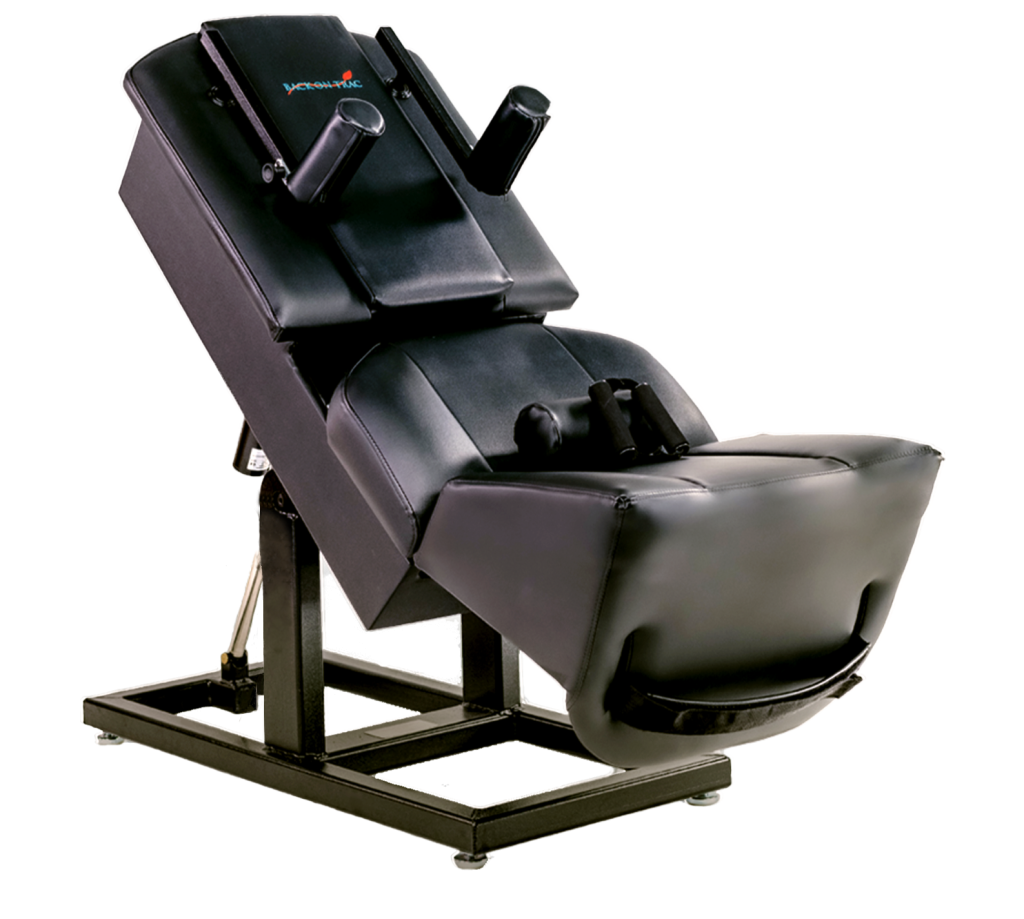
Spinal decompression therapy may also be considered for certain patients with disc-related neck or lower-back complaints.
Non-surgical spinal decompression uses a specialized table to apply controlled distraction forces to the spine. The goal is to reduce mechanical stress on sensitive spinal structures and provide a comfortable treatment environment for certain disc-related conditions.
At WellSpine KC, spinal decompression isn’t something we recommend simply because an MRI contains the words “bulging disc.”
We first need to determine whether the patient’s symptoms, examination findings, health history, and any available imaging suggest that decompression is an appropriate option.
For some patients, chiropractic care and decompression may be used together. For others, a different conservative approach—or referral to another healthcare provider—may make more sense.
When Does a Disc Problem Need More Immediate Attention?
Most back and neck pain does not represent a medical emergency, but certain symptoms require prompt evaluation.
Seek medical attention for new or progressive muscle weakness, significant loss of sensation, difficulty controlling the bladder or bowels, numbness around the groin or saddle area, severe symptoms following significant trauma, or other rapidly worsening neurological changes.
These symptoms can indicate a more serious neurological problem and shouldn’t simply be treated as routine back pain.
An MRI Finding Isn’t the Whole Diagnosis
One of the most important things to understand about bulging and herniated discs is that imaging findings need context.
As people age, MRIs frequently show changes in the spine—even in people without pain. A disc bulge on an MRI doesn’t automatically explain someone’s symptoms, and it certainly doesn’t mean that person is destined to live with chronic back pain.
A good evaluation puts the pieces together:
What does the imaging show? What symptoms are present? What does the examination reveal? And do those findings actually match?
That information helps determine what treatment, if any, makes sense.
Bulging Disc vs. Herniated Disc: The Bottom Line
A bulging disc generally involves a broader portion of the disc extending beyond its normal boundary, while a herniated disc involves a more localized displacement of disc material.
But the terminology isn’t the most important part.
Neither diagnosis automatically tells you how much pain you should have, whether you’ll need surgery, or how quickly you’ll recover.
At WellSpine KC, we look beyond the words on an imaging report. We want to understand how the disc finding relates to your symptoms, movement, neurological function, and overall condition before determining the appropriate next step.
If a disc problem is contributing to your symptoms, conservative options such as chiropractic care, spinal decompression, appropriate exercise, and activity modification may have a role depending on your individual situation.
The goal isn’t simply to treat an MRI.
It’s to help the person attached to it move and function better.


